
 ..we would all be morbidly obese
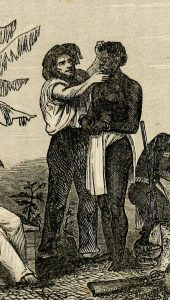
In the bustling trading town of Middletown, Connecticut, ideas were changing fast. Deacon Joseph Coe, Captain David Coe, Captain Isaac Miller and Mr. Elihu Stone announced they had voluntarily freed five slaves. The event was noteworthy enough to be reported in newspapers across New England, and given the nature of the story, you might be tempted to think this all took place during the Civil War, but this transpired several decades before, on the eve of America’s fight for independence, in February of 1775.
According to the Providence, Rhode Island Gazette, the town’s pastor, Reverend Benedict, “with many other Clergymen in Connecticut, have borne a constant testimony, both in their public and private capacities, against the infamous practice of slave keeping.”
It’s not difficult to imagine the circumstances. Some of the town’s most substantial citizens, (militia captains would be the equivalent of our police chiefs), faced the disapproval, if not wrath, of a pastor bent on changing hearts, minds, and behavior. You can well imagine the sermons, and the challenges across a table in the public house, and the public prayers given on behalf of ending slavery. Eventually the sheep feel the sting of the shepherd’s staff and they get in line. In this case, they made what would be, in today’s terms, a tremendous financial sacrifice. This isn’t a matter of boycotting the NFL on Sunday. If, as some contemporary accounts indicate, a slave sold for £40 or 50, and judging money by what it can buy in terms of labor, that would amount to a sacrifice of well over $20,000 each, in 2017 dollars.
Fortunately, in the vast majority of the non Muslim world, we’re beyond selling human beings on the auction block, but one of the primary reasons we take this for granted has to do, very much, with Christian pulpits–with pastors bent on doing more than celebrating unity and seeker-friendliness at any cost. These were pastors who wanted to change the world for Christ, and they didn’t mind bruising spirits on the way.
A few decades ago, I noticed a pattern in most contemporary Christian churches that was simply too difficult to ignore. Briefly put, the world could go to hell. The sooner the better. Christ will return any week now, and we can show Him how he took our desire for beer completely away. We can show Him how we gave up a few extra hours making sales, and a few more making mom’s life easier. Our girls can show off their purity rings, and our boys can cultivate tender, Christ-like emotions.
At first, I couldn’t put my finger on why this all felt dismal, and second rate, but in my studies of 18th century New England, I sensed a Christianity that was far more triumphant, far more hopeful, far more celebratory, and far more accountable. When you worshiped with guys who fell in alongside you for militia duty, when you built church meeting houses over a barrel of rum, when you debated policy on the basis of the Bible — then Christianity isn’t some strip-mall hug-fest with a band trying to sound like Cold Play. It’s more like the Kingdom of God, full of men and women who consider themselves adopted into the royal family–and expected to do noble things. There’s a reason that generation brought a mighty king’s army to defeat; they considered themselves crown princes. Their pastors saw them as sons and daughters of the most high God, the Lord of Hosts, the Prince of Peace — and they were going to get the spiritual education, and the buffeting, given to a prince–thank you very much.
Compare that to the sorry series of apologies and vagaries a local pastor gave in a recent message. At the outset, let me just say I sympathize. I’ve managed enough people, and raised enough children, to know that holding together a coalition, or a congregation, is difficult. It gets particularly difficult when I know that failure will adversely affect my living, and I truly feel sorry for men who need to make their livings from an offering.
But we need to begin considering why Christianity isn’t really changing the culture. John MacArthur, and other teachers who appear weary of politics, gives us some high-minded sounding advice on this one. “Convert people to Christ and the culture will change naturally.”
How’s that been working out for us? With so many stadium revivals, so much Christian broadcasting, so many national days of prayer, why do we live in a world where a twelve year old girl can be taken to an abortionist without her parents’ consent? Why can NFL millionaire-ingrates make overtly racist appeals for “black lives matter” but a Christian baker can’t even refuse to bake a cake that violates his conscience? Where are the crown princes of Christianity in the public square?
I’ll tell you where they are: Cowering behind their pastor, who is cowering behind his pulpit, making excuses for the weakest, shrillest social justice warriors in his congregation. The church, far from being the “called out,” has become “call just about anyone who will come.” Most of these congregations are full of people who truly want to change, to learn, to allow Christ to change them and their communities, but pastors hedge on their sermons to please the young Marxist in the back or the hip anarchist who refuses to vote or the welfare fraud who is on her third husband. At best, everything’s about finding that one lost sheep, and, at worst, it’s just about building market share.
It certainly isn’t about building the kingdom of God, because kingdom-builders have mind, and heart, and muscle and knowledge. Kingdom builders don’t mind being challenged, told to give up their slaves, told to cry out against abortion, told to “judge righteous judgment.” Kingdom builders don’t mind being told, “if you vote for pro-abortion politicians, you should not be taking the Lord’s supper.”
On the contrary, the poor local pastor I’m referencing, (it all gets really fudgy around 34:00), while lamenting the “divisiveness” of today’s political and cultural climate, (who doesn’t share that lament?) appears to advocate that the church’s “transcendent,” “other-wordly” posture shouldn’t merely be a place on the continuum between the crazy left and crazy right. In the search for that transcendence, the pastor offers some concrete advice: “change the subject.” Quoting Oliver O’Donnel approvingly, the pastor finds a teaching moment in saying nothing of consequence at all:
Not every wave of political enthusiasm deserves the attention of the church in its liturgy. Judging when political questions merit prophetic commentary requires a cool head and a theological sense of priorities. The worship that the principalities and powers seek to exact from mankind is a kind of feverish excitement. The first business of the church is to refuse them that worship. There are many times – and surely a major Election is one of them – when the most pointed political criticism imaginable is to talk about something else.
Concerned about slavery, Captain Coe? Let’s talk about something else, shall we? Are you wondering if a Hillary Clinton presidency will be good or bad for the supreme court and religious liberty? Let’s change the subject. Can I give you a hug?
There are times when “transcendence” gets so spacey, it just becomes “confusion” or “apathy” or some other sort of gas.
And then, in an attempt to get a tad more specific, the pastor, borrowing a set of resolutions I believe are attributed to John Leeman of GospelCoalition.org. (There’s that word again “coalition.”) Among those marvels of “transcendence” is this jewel:
“You who proclaim that all lives matter, who are your friends? Do they all look like you?”
What does that even mean? We can’t declare a basic gospel truth, (“all lives matter”) without embarking on an affirmative action friend-recruiting campaign? We only get to criticize the anarchic, racist “black lives matter” movement if we’ve recruited a few black conservative friends to stand with us? You know what happens to blacks who criticize race-pimping antifa activists? Take a look. The apostle Paul didn’t legitimize his ministry by making sure every ethnicity was represented on the stage behind him. This sloganeering is nothing more than cheap, topical pandering. It’s not critically acute, mind and heart changing, gospel preaching.
It certainly is true that transcendent change begins inside the church, that abortion, for example, becomes unthinkable in society when it becomes unthinkable among God’s people. But poisonous ideas, hammered out of the minds of God’s family, need critical and repeated condemnation under the truly “transcendent” light of scripture. They can’t be reduced to personal virtue bumper stickers, nor will the kingdom of God advance if the congregation has been made to think apathy (and changing the subject) is actually a virtue.
Contrary to John MacArthur’s advice, baby Christians, like seed thrown on stone, don’t just sprout, or grow, without sweeping them into the mud, without constant attention, nurturing, and pruning. Like Pastor Benedict, you actually may have to give some real scorching sermons on slavery, brother. You may have to get in their face. You may have to make them feel uncomfortable. You may have to withhold communion from abortion voters, and welfare frauds, and swindlers. You may have to get more divisive, not less.
Call yourself a personal trainer and kick their ass. This generation just might understand that one.

As someone who is outside of Protestant Christianity, I hope you don’t mind if I ask a sincere but provocative question about this post.
I have listened to enough Christian radio and television to understand how reformed theology is explained to the public. Basically, we are told that we have a sinful nature that we are powerless to overcome on our own merits; that we are saved by acknowledging that Jesus Christ has atoned for our sins; that once we are saved, God will transform us; and that our salvation is assured and cannot be lost by anything that we choose to do (or fail to do) in the future.
I do not know if this is a completely accurate explanation, but I am sure that this is how it would be reasonably understood by any intelligent, non-skeptical person who listens to the average pastor on radio or
television; and if you google “what must a Christian do to be saved”, this is pretty much what you’ll get. That being the case, it is hard to see how there is any room to argue that evangelicals have a personal moral obligation to make the world a better place. The pastor cannot easily tell them that their salvation depends on it, nor can he say that God is powerless to make them do His will – at least not without adding some major qualifiers to the conventional salvation formula.
They can also see how mainline Protestant denominations have become the functional equivalent of progressive Political Action Committees; and without any commonly recognized authority or moral
doctrine to place boundaries on the scope of political activism, they ought to have a legitimate concern that their personal moral sensibilities will be coopted by fellow congregants who are intent on using the church as the means to impose their own social justice priorities on everyone else.
In other words, it seems (at least to an outsider to the faith) that once a Christian has been saved, and has a personal assurance of salvation, he has no self-interested reason to stick his neck out and undertake
the hard and thankless task of confronting our corrupted modern culture. In fact, he can assume that if he doesn’t want to do it, it must not be part of God’s plan. He can even point to scripture to support the proposition that he is no longer “of this world” – which, as I understand another tenet of reformed
theology, he is expected to personally interpret without rote deference to any intermediating authority, even his own pastor.
Obviously, many Christians heroically engage the culture, perform great acts of charity, and transform hearts and lives. But as you point out, others are satisfied to just sit on the sidelines. So I am curious – what is reformed theology’s argument for political engagement by Christians who believe that they are already saved, and find politics to be distasteful?
You’ve correctly identified what may seem to be the flaw in Calvin’s interpretation of scripture, but scripture really doesn’t need much interpretation on this head. Calvin simply read and repeated Holy Writ. “We were dead in our sins.” Ephesians 2 “For he chose us in him before the creation of the world to be holy and blameless in his sight. In love” Christians are chosen, not made of their own free will. Someone, however, can profess to be chosen, elect, and not be. A true believer will grow in grace and wisdom. If a masterful artist carved an image of a newborn, matching the real newborn in every respect, the new creation would begin to change, but the wooden statute would remain the same . The proof of election will be seen in the believer’s life — and he will subject himself to the teaching and reproof of Godly men.
But I would have no problem with a Catholic priest giving a hellfire and damnation sermon to pro-abort Catholic politicians. Good to hear from you, James.
I couldn’t agree with you more about the long overdue admonishment of pro-abortion Catholic politicians. If one believes (as Catholics do) that our salvation is contingent on our personal exercise of free will to act with charity towards others, to avoid sin, and to formally ask forgiveness and obtain remission for our sins when we fail, then it makes perfect sense to threaten us with hellfire if we promote (or even passively tolerate) abortion. But as far as I can tell – and I would remind you that I have no way to know if this is accurate – evangelical Christians are told that there is no correlation between their personal conduct and their salvation – and that in fact, as you point out in your response, whatever good that they do in this world is not of their own free will and is merely the evidence of God working within them. I don’t want to dispute that theological understanding, and for purposes of this discussion I’ll assume it is true; but if so, what would be the purpose of threatening hellfire to church-going Christians (who believe themselves to be saved) if they don’t oppose abortion or slavery? Either they are not among the elect in the first place, in which case no amount of pro-life advocacy can save them, even if they were inclined to pursue it; or they are already among the elect, in which case they will presumably grow in grace and wisdom without threats of damnation (which would be empty threats in any event). There may well be some middle path that reconciles all of this, and maybe everyone inside of your church gets it, but I think you should understand that on its face it is a paradox – and perhaps not only to those of us on the outside.
It’s a mystery as profound as the thief on the cross — promised paradise merely because he had been given the capacity to recognize the King. The pastor or the missionary, in this view of scripture, isn’t actually “making converts.” He has the high honor of witnessing their re-birth. Judas was both culpable and incapable of escaping his destiny. Pharoah, and several other Canaanite kings had no choice but to be cursed with “hardened hearts.” I don’t pretend to feel entirely comfortable about being an actor in a play, but I’ve learned to take comfort in the fact that I’m not the author and the Author knows what He’s doing. The pastor and the prophet have no choice but to give the warning even though God knows the outcome.